

The Spanish Immigration System
Spain operates a national regulatory framework administered locally in Madrid through the Government Delegation (Delegación del Gobierno), the provincial Immigration Offices (Oficinas de Extranjería), and the National Police (Policía Nacional).
While statutory laws apply across Spain, local processing timelines, appointment availability (citas previas), and municipal registration rules vary directly depending on your specific municipality and district.
Essential Rule for Renting & Empadronamiento
You do not need the green NIE or a finalized residency card to secure a rental property. Under the Spanish Urban Tenancy Act (LAU), you can legally execute and sign your residential lease (contrato de arrendamiento) using your valid passport.
Having your fully executed lease contract is the mandatory legal prerequisite to register your local residence at the town hall (empadronamiento). Note that the empadronamiento can only be registered on or after the formal start date of your lease agreement, never in advance.
EU / EEA / Swiss Nationals Moving to Spain
Citizens of the European Union, the EEA, and Switzerland benefit from free movement under EU treaties and do not require an entry visa or prior work authorization.
When staying longer than 90 days, EU/EEA/Swiss citizens are legally required to formalize their residency with the Central Register of Foreigners (Registro Central de Extranjeros) to obtain their EU Registration Certificate (Certificado Verde), which contains their permanent NIE.
Non-EU / Non-EEA Nationals Moving to Spain
Nationals of countries outside the EU, EEA, and Switzerland (including UK and US citizens) require formal legal authorization before establishing residence or taking up employment in Spain.
Depending on your relocation profile, immigration pathways generally fall under two distinct tracks:
- The Fast-Track Talent & Corporate Route (Law 14/2013): For corporate transferees, intra-company personnel, and highly qualified specialists processed via the Large Business and Strategic Collectives Unit (UGE-CE).
- The General Consular Route: For standard local hires or non-lucrative residents processing initial clearances through the competent Spanish consulate in their home country.
Regulatory Framework & Compliance Traps
- Mandatory Private Health Insurance: Spanish immigration authorities systematically reject standard travel insurance or expat policies with deductibles. The policy must strictly meet statutory standards: zero co-payments, no waiting periods, uncapped medical coverage equivalent to public healthcare, medical repatriation, and full upfront annual payment.
What the NIE is Used For
Your permanent fiscal and administrative identification number is required to:
- Register domestic utilities (water, electricity, gas, high-speed fibre broadband).
- Open a resident bank account and configure automated direct debits (domiciliaciones).
- Register with the Spanish Social Security system (Seguridad Social) and receive your public health card (for employed residents, self-employed workers, or eligible beneficiaries).
- Obtain the official software-based Digital Certificate (Certificado Digital) to manage public administration online.
- Register or import a vehicle and obtain a resident street parking permit (SER).
- Exchange an eligible foreign driving licence for a Spanish permit (canje).
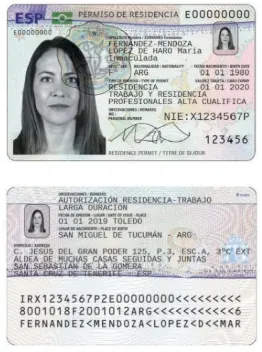
Example of TIE (Tarjeta de Identidad Extranjero)
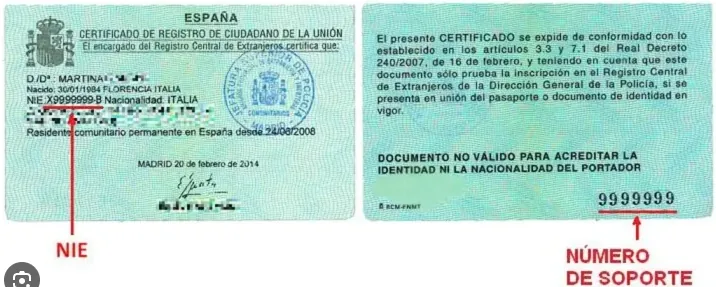
Example of EU Registration Certificate (Certificado Verde)
Pro Tip: How to Enter the Número de Soporte on Spanish Online Portals
When using Spanish public administration platforms (such as the Tax Agency/Hacienda, Social Security, Cl@ve, or booking a cita previa), forms frequently ask for your Número de Soporte (document ID number) alongside your NIE.
The system strictly requires an exact 9-character alphanumeric code, which often confuses EU citizens because the physical green certificate only displays 7 or 8 digits.
How to format the 9 characters for EU Green Certificates (Certificado Verde):
- Always start with a capital "C": For EU citizen certificates (Certificado de Registro de Ciudadano de la Unión), the support code must begin with the letter C.
- Add leading zeroes (0) if necessary between the letter "C" and your document digits to reach exactly 9 characters in total:
- If your certificate displays 7 digits (e.g., 9999999): → Enter C + 0 + your 7 digits → C09999999 (1 letter + 1 zero + 7 numbers = 9 characters).
- If your certificate displays 8 digits (e.g., 12345678): → Enter C + your 8 digits → C12345678 (1 letter + 8 numbers = 9 characters).
Non-EU Residents Note (TIE Card): For holders of the plastic biometric Foreigner Identity Card (TIE), the número de soporte is located in the upper-right corner and already comes in the 9-character format starting with the letter E followed by 8 digits (e.g., E12345678). No adjustments are required.
How Welcome Service Spain Coordinates Your Process
Navigating Spanish immigration independently carries substantial administrative friction. We manage the entire transition through our secure REX platform:
- Document Audit: We review civil status records, employment proofs, and insurance contracts in advance to eliminate any risk of rejection.
- Synchronized Appointments: We monitor booking platforms daily to secure municipal and police dates that perfectly align with your lease start date and legal validity windows.
- Paperwork & Formalities: We assemble official application forms, calculate and generate statutory tax receipts (tasas), and ensure your entire file is compliant before submission.
- In-Person Accompaniment: A dedicated consultant accompanies you in person to both your town hall and police appointments to manage communication with local officials and ensure immediate issuance.
Frequently Asked Questions (FAQ)
What permits do I need to live in the Community of Madrid?
The required permits depend strictly on your nationality and relocation profile:
- EU / EEA / Swiss Citizens: Benefit from freedom of movement and do not need a visa or work permit. For stays over 90 days, you must register on the Central Foreigners Register to receive your EU Registration Certificate (Certificado Verde), which bears your permanent NIE.
- Non-EU Citizens (including UK and US): Must obtain prior authorization before arrival, either via the expedited Corporate & Talent framework (Law 14/2013) or through a consular visa in your home country. Once in Madrid, you must attend an in-person police appointment (toma de huellas) to register fingerprints and obtain your physical biometric residency card (TIE).
In all cases, legal residency follows a mandatory chain: you must first execute your residential lease, complete your municipal registration (empadronamiento), and only then attend the National Police appointment.
What Health Insurance Criteria Must I Meet for Spanish Residency?
Spanish immigration authorities enforce strict standards for private medical insurance when processing non-EU residency applications or registering non-working EU citizens.
Standard international travel insurance, corporate packages with deductibles, or basic expat policies are systematically refused. Under Spanish law, your insurance policy must satisfy non-negotiable criteria:
- Underwritten by an insurance entity officially licensed in Spain.
- Zero co-payments (sin copago) for consultations, diagnostics, or procedures.
- No waiting periods (sin carencias), effective from day one.
- Full, uncapped coverage for hospitalization and surgery, equivalent to the Spanish National Health System.
- Full medical evacuation and repatriation coverage.
- Full-year premium paid upfront, certified by an official one-page certificate (Certificado de Coberturas) drafted explicitly in Spanish.
How do I register with my municipality (Ayuntamiento)?
Municipal registration, known as the empadronamiento (or el Padrón), is the official record of your household on the municipal population census.
It is the essential administrative bridge between securing your home and obtaining your legal residency:
- Strict Timing: It can only be executed on or after the official start date of your lease agreement (never before).
- The 90-Day Police Rule: The municipal certificate (volante de empadronamiento) must be less than 90 days old on the day of your police residency appointment.
- Public Services: Beyond immigration, the padrón is the geographic proof required to secure local school placements, access neighborhood public health centers (Centros de Salud), and apply for residential street parking permits (SER).
Because each district and suburban municipality (Madrid City, Pozuelo, Alcobendas, Majadahonda) manages independent booking calendars and strict document validation, securing synchronized appointments is critical to avoiding procedural delays.
Do children need to attend the Town Hall (Padrón) and National Police appointments in person?
The rules regarding in-person attendance for minor children depend on the specific procedure:
- Town Hall Registration (Padrón): Minor children generally do not need to attend in person. Parents can register their dependent children on their behalf, provided original passports and properly authenticated birth certificates (apostilled and translated by a certified Spanish sworn translator) are presented. If only one parent attends, written formal consent from the other parent is legally required.
- National Police Appointments:
- Non-EU Families (Biometric TIE Fingerprinting): Every child receives a plastic TIE card with their photo printed on it, regardless of age. Children aged 6 and older must attend the appointment in person for biometric fingerprint capture (toma de huellas). Children under 6 years old are exempt from fingerprinting, and their physical presence is generally waived in most Madrid police stations as long as parents submit the child's original passport and a compliant physical passport photo. Both parents (or one parent carrying a signed authorization and ID copy from the other) must attend.
- EU Families (EU Green Certificate / Certificado Verde): A parent or legal guardian can represent minor EU children during the registration procedure using the child's original passport and authenticated birth certificate, though bringing the child is often recommended to prevent administrative pushback at certain police stations across Madrid.