Overview: Driving in Madrid
Whether you relocate with your personal vehicle or purchase locally, driving in Madrid involves distinct administrative steps: customs clearance, vehicle registration (matriculación), driving licence exchange, and low-emission regulations.
Welcome Service Spain manages vehicle registration and driving licence exchanges as a turnkey coordination service, steering the procedure end-to-end with our accredited administrative team (Gestoría Administrativa).
Bringing Your Car to Spain
Importing a vehicle involves statutory deadlines and potential tax exemptions based on your relocation status.
Under Directorate-General for Traffic (DGT) regulations, foreign-plated vehicles cannot legally circulate once you establish official Spanish residency. Because vehicle homologation, technical inspections, and formal registration take several weeks, you (or your gestoría) must apply for provisional green plates (placas verdes).
Tax Exemption: Change of Residence (Cambio de Residencia)
You can import your vehicle exempt from import VAT (if coming from outside the EU) and the Spanish Registration Tax under specific conditions.
Non-Exempt Vehicle Imports
If your import does not qualify for the relocation tax exemption:
- Non-EU Origins: Incur statutory customs duties and import VAT cleared via the official single administrative customs document (DUA).
- Registration Tax : Incurred on non-exempt vehicles, with tax rates tiered from 0% up to 14.75% based on the vehicle's official CO2 emissions rating.
Welcome Service Spain coordinates this process end-to-end alongside our partner gestorías, managing ITV appointments, filing tax exemptions within the legal window, securing provisional green plates, and delivering the vehicle fitted with Spanish plates to your residence.
Motor Vehicle Insurance
Driving without valid motor insurance is illegal in Spain and monitored automatically via automated number-plate recognition (ANPR) cameras linked to the national insured vehicle database (FIVA).
Spanish insurers offer three primary levels of coverage:
- Third-Party (Terceros Básico): Mandatory statutory minimum cover for civil liability and third-party property damage.
- Extended Third-Party (Terceros Ampliado): Mandatory liability plus fire, total theft, windscreen and window breakage (rotura de lunas), and comprehensive 24/7 roadside assistance from kilometre zero (asistencia en viaje). This is the standard baseline chosen by most vehicle owners.
- Comprehensive (Todo Riesgo): Covers accidental damage to your vehicle, available with or without a deductible.
Bonus-Malus Tip: Spanish insurers recognize overseas driving history. Always obtain an official No-Claims Certificate (Certificado de Siniestralidad) covering the last 3 to 5 years from your previous insurer prior to moving. Submitting this record can reduce your annual premium by up to 50% with major Spanish providers like Mapfre, AXA, Allianz, or Mutua Madrileña.
Driving Licences in Spain
The legal framework governing your foreign driving licence depends on the issuing country:
- EU / EEA Licences: Remain valid in Spain until their official printed expiry date without mandatory exchange. However, EU licences issued without an expiration date (or valid indefinitely) must be renewed or exchanged with the DGT after two years of legal residence.
- Non-EU Licences (including UK, Swiss, and third-country permits): Legally valid for driving in Spain for only 6 months from the date you obtain legal residency. Before this 6-month grace period expires, you must process an exchange:
- Countries with Bilateral Agreements (UK, Switzerland, Andorra, Monaco, and several Latin American nations): Direct exchange (canje) without theoretical or practical driving tests.
- Countries without Bilateral Agreements (USA, Canada, Australia, etc.): Direct exchange is not permitted. Once the 6-month window elapses, you must enroll in a Spanish driving school (autoescuela), pass the psychotechnical medical test, and successfully complete both the DGT theoretical code exam and the practical road driving test.
Procedure for Driving Licence Exchange (Canje de Permiso)
- Medical Fitness Test (Informe de Aptitud Psicofísica): Complete a 20-minute physical and psychomotor evaluation at an accredited driver examination center
- DGT Filing: Submit the completed DGT application forms
- Temporary Driving Permit: The DGT retains your physical foreign driving licence and issues an immediate paper driving authorization (Autorización Temporal para Conducir, valid for 3 months in Spain). Your definitive plastic credit-card licence is delivered to your registered residential address by post within 4 to 8 weeks.
Driving in Madrid & Road Regulations
- General Rules: Drive on the right; seatbelts are mandatory for all occupants.
- Mobile Devices: Using a handheld mobile phone while driving or manipulating a phone mounted on a dashboard cradle while moving is strictly prohibited (incurs a €200 fine and the deduction of 6 points).
- Speed Limits:
- 120 km/h on motorways (autovías and toll autopistas).
- 90 km/h on standard secondary and rural roads.
- 50 km/h on urban avenues with two or more lanes per direction.
- 30 km/h on single-lane city streets (the standard default limit throughout residential Madrid).
- 20 km/h on shared pedestrian/vehicle streets.
- Toll Roads vs. Free Expressways: Most national expressways (autovías) are completely toll-free. Radial motorways exiting Madrid (R-2, R-3, R-4, R-5, AP-41) are private toll roads (autopistas) payable by cash, contactless bank card, or electronic toll transponders (Via-T).
- Winter Driving: Winter tyres and chains are not mandatory nationwide. However, carrying snow chains or running certified 3PMSF winter/all-season tyres is legally mandatory when driving across the Sierra de Guadarrama mountain passes during adverse weather alerts.
Madrid Low-Emission Zones (ZBE & Madrid 360)
The entire municipality of Madrid operates under low-emission regulations monitored by automated camera networks:
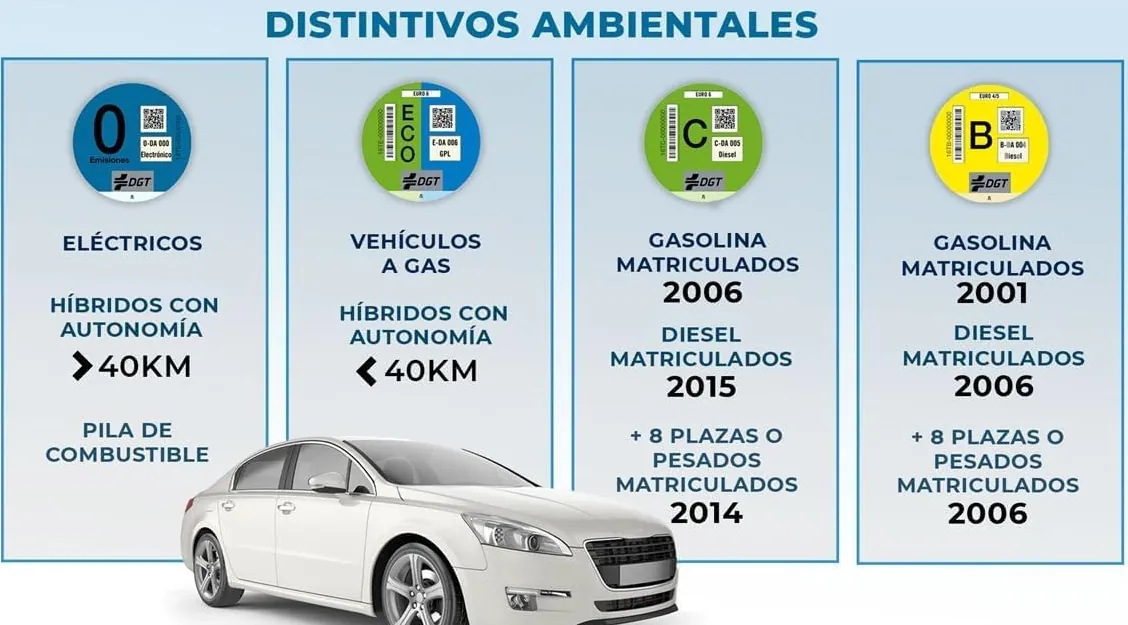
- DGT Environmental Sticker (Distintivo Ambiental): Displays your vehicle’s emissions rating. Required to circulate or park legally within the municipality. Purchase it for €5 at any Correos (Post Office) branch by presenting your vehicle registration papers:
- 0 Emisiones (Blue): 100% electric and long-range plug-in hybrids. Free parking on all street bays and unrestricted city center access.
- ECO (Blue/Green): Hybrids and gas vehicles. Unrestricted access and reduced parking rates.
- C (Green) & B (Yellow): Modern combustion engines. May circulate freely along ring roads and outer districts, but entering the historic center (ZBE Distrito Centro) requires driving directly into an authorized underground public parking facility.
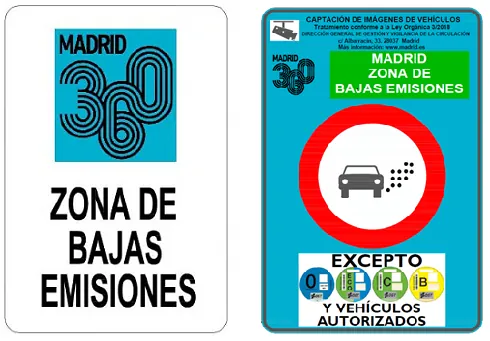
- No Sticker (Sin Distintivo / Categoría A): Older, non-compliant vehicles (petrol pre-2000, diesel pre-2006) are strictly barred from circulating anywhere within the municipality of Madrid.
Parking in Madrid
On-street parking in central Madrid is governed by the Regulated Parking Service (SER):
- Green Bays (Plazas Verdes): Intended primarily for residents. Non-residents may park for a maximum of 2 hours at standard rates.
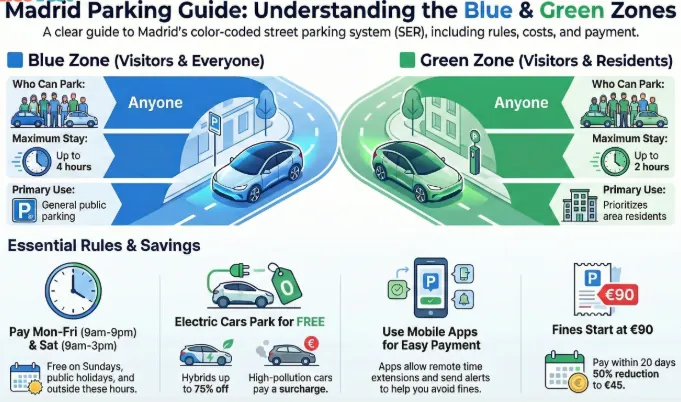
- Blue Bays (Plazas Azules): Designed for short errands and commercial visits. Maximum stay of 4 hours.
- Hours of Operation: Monday to Friday 09:00–21:00; Saturday 09:00–15:00. Free on Sundays, public holidays, and during August afternoons (after 15:00).
- Mobile Payment Apps: Pay and extend parking without visiting the street meter using Telpark, EasyPark, or ElParking.
- Annual Resident Parking Permit (SER Residente): If you are registered on the municipal census (empadronado) in a SER district and your vehicle’s IVTM road tax is registered to that address, you qualify for an annual resident permit for €24.60 / year, allowing unlimited free parking on green bays within your district sector.
- Underground Garages: Older residential buildings in central districts often lack private parking. Private monthly garage spaces in Salamanca, Chamberí, Centro, or Retiro range from €120 to €250 / month.
Buying, Leasing & Electric Vehicles
- Vehicle Purchase & Leasing: Madrid hosts major official dealerships along the A-6 (northwest corridor) and the A-1. Personal and business contract hire (Renting) is widespread among expatriates, packaging maintenance, ITV inspections, full-risk insurance, and road tax into one single monthly payment.
- Electric Vehicle Charging: Madrid has expanded its public on-street fast-charging points (operated via Electro-EMT, Endesa X Way, or Iberdrola). Most modern residential compounds and commercial underground parking garages provide dedicated EV wallboxes or pre-installation conduits under Spanish horizontal property laws.
Car Sharing Alternatives
If you prefer not to own a vehicle, Madrid has one of Europe’s largest 100% electric free-floating car-sharing fleets:
- Providers: Free2Move, Share Now, Zity, and Wible offer thousands of self-service compact electric cars accessible via smartphone.
- The Low-Emission Advantage: Because these fleets hold official 0 Emisiones certification, you can drive through restricted central environmental zones without restrictions and park for free on all street Green and Blue SER bays without taking a parking ticket.
- Long-Distance Rentals: For weekend excursions, high-speed rail terminals (Atocha and Chamartín) and Barajas Airport host major vehicle rental branches (Sixt, Avis, Hertz, Europcar).
Frequently Asked Questions (FAQ)
Do I need the Spanish DGT environmental sticker (pegatina) for my car in Madrid?
The requirement depends on whether you have just arrived with foreign plates or have finalized your Spanish residency:
Phase 1: Upon Arrival as a Non-Resident (Foreign Plates)
- You cannot buy the Spanish DGT badge in advance: The physical Spanish sticker is issued exclusively to vehicles registered in the Spanish national vehicle registry. While driving on foreign plates, you cannot obtain or order it.
- Vehicles with Recognized Badges (France, Germany, Austria, Denmark): You do not need to buy anything in Spain. Keep your national badge (such as the French Crit’Air or German Umweltplakette) affixed to your windscreen. Madrid’s traffic enforcement systems and municipal police officially recognize these as legal equivalents.
- Vehicles without a Windscreen Badge (UK, Belgium, Switzerland, etc.): Keep your vehicle's original registration certificate in the glove compartment to prove its engine standard (Euro 4, 5, or 6). If entering the historic center (ZBE Distrito Centro), you must drive directly into an authorized underground public car park so the facility electronically validates your entry with the municipal mobility system, preventing an unauthorized access penalty.
- Non-Compliant Vehicles (Category A): Older vehicles (petrol pre-2000, diesel pre-2006) are strictly barred from circulating anywhere within the Madrid municipality.
Phase 2: Once You Become a Spanish Resident (Spanish Plates)
- Mandatory Spanish Badge: Once your relocation consultant and partner gestoría complete the import process (matriculación), your car receives official Spanish license plates and an updated registration certificate (Permiso de Circulación).
- Foreign Badges Expire: Foreign stickers (including Crit'Air) are no longer legally valid once the car is registered in Spain.
- Issuance: You must display the official Spanish DGT badge, which can be printed on the spot at any Madrid post office (Correos) for €5 upon presenting your Spanish vehicle registration document.
What are the parking and low-emission rules in Madrid?
- Low-Emission Zones (ZBE & Madrid 360): The entire municipality of Madrid is an environmental protection zone. Vehicles must display an official DGT environmental sticker (Distintivo Ambiental, €5 at Correos):
- 0 Emisiones & ECO: Unrestricted access across the capital, plus discounted or free on-street parking.
- C & B: Can circulate freely along motorways (M-30, M-40) and outer districts. However, entering the historic downtown (ZBE Distrito Centro) requires driving directly into an authorized public underground car park.
- No Sticker (Sin Distintivo): Older non-compliant vehicles are barred from circulating within the Madrid municipal limits unless they were registered in the city's vehicle tax census prior to 2022.
- On-Street Regulated Parking (SER):
- Green Bays (Plazas Verdes): Prioritize neighbourhood residents. Non-residents can park for a maximum of 2 hours at standard rates.
- Blue Bays (Plazas Azules): Geared toward short errands and visitors, with a maximum stay of 4 hours.
- Payment & Hours: Regulated Monday–Friday (09:00–21:00) and Saturday (09:00–15:00). Pay at street terminals or via mobile parking apps like Telpark, EasyPark, or ElParking.
- Resident Parking Permit (SER Residente): If you are registered on your local municipal census (empadronado) and your vehicle’s IVTM tax is billed to your Madrid address, you can apply for an annual permit for €24.60 / year, giving you unlimited free parking on green bays within your designated neighbourhood sector.
What mandatory equipment and documents must I carry in my car in Spain?
Under Spanish traffic law (DGT), you must keep the following items inside your vehicle:
- Official Vehicle Documents: Your original valid driving licence, vehicle registration certificate (Permiso de Circulación), and valid ITV inspection card with the sticker displayed on the windscreen.
- Reflective Vest: At least one high-visibility vest stored inside the cabin (glove box or door pocket), easily accessible before stepping onto the road. Carrying one per passenger is strongly recommended.
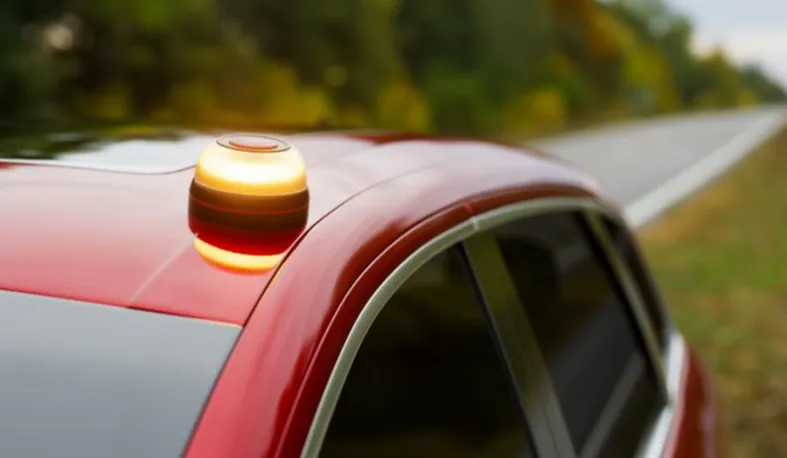
- Emergency Signalling Device: Since January 2026, an approved DGT-connected V-16 flashing beacon light (baliza V-16 geolocalizada) is mandatory for all Spanish-registered vehicles, replacing traditional warning triangles, used to signal a breakdown without walking along the motorway.
- Spare Tyre or Repair Kit: A functional spare wheel with its jack/tools, or a certified tyre puncture repair kit.
What are the rules for child car seats in Spain?
- Height Requirement: Children measuring 135 cm or less must travel in an approved child car seat (Sistema de Retención Infantil – SRI) matched to their height and weight.